
Why chasing twitter's approval doesn't work
The opinions you believe are universal are being fed to you by an algorithm designed to show you things you agree with

Every few months on the video game discourse calendar, we get an entry like this.
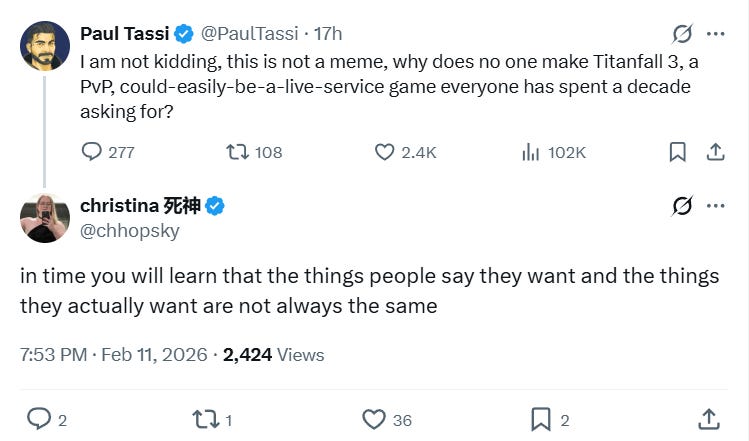
And every few months, a handful of people who’ve actually done the work on this have to explain why treating social media as an absolute source of truth is a mistake.
Here is a short and incomplete list of the reasons why doing what you think social media says is not the free win you think it is.
Sampling Bias
You’re listening in the least honest location
What people say is affected by who is listening.
People who do and say things on social media are doing so for social interaction, and these interactions are the driving reward behind it. We know that people will repeat opinions they don’t even hold so long as they believe that other people believe they are correct. We also know that people shy away from opinions that receive social punishment. The 2026 environment of gaming discourse on Reddit/social sense is dominated by Being Right About Games where the goal is not to discuss but to Know Things. This creates a problem, because feedback should be a personal experience, but instead, you’re rewarded for being Right and punished for being Wrong. There is no such thing as a wrong personal experience, so as long as it’s actually yours.
That’s where it gets tricky, because in that social space, content creator opinions get repeated by their fans as correct as part of a desire to affirm themselves as Knowing Things, and to affirm their creators as knowledgeable, despite the creator’s opinions rarely actually relating to the player at all, either through Elo or consumption habits. Of course a Challenger-ranked player is affected differently by a small change than a Bronze player. Of course someone who plays games on stream 8 hours a day runs out of content faster than someone who plays an hour a night.
Groupthink runs rampant in these kinds of communities once they convince themselves something is true. Remember the origin of “We did it, reddit”? A bunch of redditors convinced themselves they’d found the Boston Marathon bomber, and went after some random guy, who it turns out, killed himself.
Social media perspective differs per subject
So now everyone thinks they’re right because everyone agrees on a particular topic.
…until you bring algorithms into play, which divide opinions into clusters. You end up with multiple clusters of players on a social media site, all of whom believe their opinion is the one that’s universally held, because the software is specifically designed to feed you more of the opinions you want to see.
The things you believe are “universal” may very well just be the algorithm working as intended and showing you things you like. Your Twitter feed is not even representative of Twitter as a whole, let alone the player base.
The people you’re listening to aren’t even your players
Once something is being discussed in public, people get social rewards for discussing it and saying the right opinions. A staggering number of people will chime in about games they have never even played and repeat an opinion they believe to be Right, because again, Being Right About Games is what matters.
Let me be extremely clear about this. People who have never played your game will give you feedback about it.
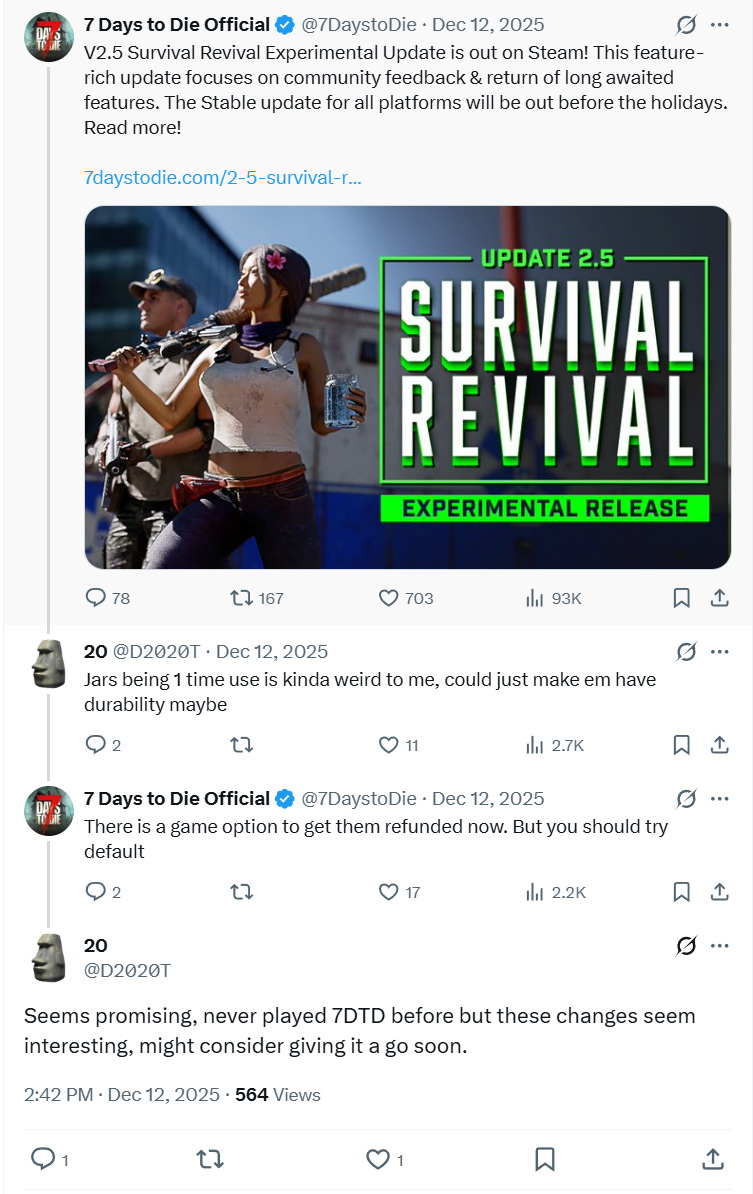
This extends into Steam review bombing, where once a Correct Opinion has been formed, people who haven’t played the game will rush to Steam to punish it, again, despite not having actually played it. The feedback they provide is not about the game, it’s about an opinion they believe to be correct based on the crowd.
Even the ones that are your players are a minority of your real players
Every live service game learns this over time. League of Legends, Overwatch, Apex Legends, Dauntless… we all chased Reddit’s approval at the direction of product managers, then watched our player counts crumble. The stark reality is that only a tiny fraction of ANY player base is on social media, and the ones that provide feedback aren’t a representative sample of the overall player base. Even if you get past this selection bias, people complain after only slightly bad experiences, but an experience generally has to be great in order for someone to leave positive feedback, so you aren’t even getting a representative sample of the opinions of the group you are seeing. Treating what you hear there as a global consensus is a recipe to crater your game, and every game that tries this learns the hard way.
Self-reporting Bias
When you share an opinion or give feedback, you are telling a story about yourself. People want to share a story that they like, and that makes them feel skilled, or knowledgeable. They do not write the honest objective truth about themselves into these things. They write the version that they wish they were. We know this because we’ve surveyed a lot of players over the years and then compared their answers with their actual behavior data, and the two rarely have anything in common.
Whenever you give someone the opportunity to tell you a story, they’re telling you a story that reflects on them the way they want to be seen, and you need to take this into account when deciding what to take away from it.
Frequently wrong about themselves
Sure, there are complex psychological issues at play, but surely people can at least be trusted to tell you about themselves, right? Unfortunately not.
A particular AAA developer I know of once sent surveys to 1000 players asking them which game they had played the most, then compared it with the data of what they had actually played. Not a single one answered correctly.
Zero out of one thousand players could remember their own habits enough to tell which game they’d played the most. Player answers were so consistently wildly wrong that the team involved thought that their data must have been corrupted. Upon validating that it was in fact accurate, they went back to the players and told them what their actual most played games were, and every single one said something along the lines of “OH! Right. Well, that makes sense”.
When people tell you things they’re really telling you the stories they tell themselves about themselves, and those stories may not have anything at all to do with reality.
Experiential projection
If they can’t speak accurately about what they have experienced, how are they supposed to guess how they’ll feel about things they haven’t?
Turns out, people are terrible at telling how they’ll feel about something they haven’t experienced. This seems like a pretty obvious thing to say, but it goes wrong easily, because researchers often tend to treat a question about “how a player feels about something they’ve experienced” the same as “how they think they might feel about something new”.
This is a trap, because people who are offered a new option often fixate on what they would be losing if the old option went away, and because they haven’t experienced the benefits of the new one yet, they can’t actually place those two as equal. Those kinds of questions are great research for discovering what players are afraid of, not what they actually want. The classic case of this is The Guy Who Tried To Ruin Halo 2.
In the lead up to Halo 2, players were asked what they think about queueing up instead of using fixed servers. Results were overwhelmingly negative, because they focused on losing the servers they were used to, but couldn’t preempt the benefit they’d receive from being able to queue, so they answered based on what they thought they’d lose, and said they didn’t want it. When Trueskill queue launched with the game, it was a huge success and it was so influential that it changed the landscape of online gaming forever.
It’s staggeringly easy to completely misinterpret what players are telling you if you’re not paying close to attention to the conditions under which you’ve asked.
Subject matter expertise
There was a time where in order to be a PC gamer, you needed to have a good grasp on technology. That time has passed. Most players have no expertise in computers or games. Unfortunately, they tend to believe that they do, and they have no idea that it isn’t true. With their whole chests, they will declare you stupid for not implementing their “easy solution” to a problem they believe exists in a game, and then when you look further you discover something that obviously, fundamentally cannot work. There isn’t a way around this.
I once saw a player in the top 0.5% of League ranks say that the fix for tanks doing too much damage was to put -10% damage output on Tank Mythic items.
Mythic items were a type of item in League of Legends. You could only have one “Mythic” item, and it would give extra stats or behaviors to every additional completed item. Tank mythics would give additional health or resistances, mage mythics would give extra ability power, etc. They have since been deprecated.
This could never have worked for many reasons, listed in the thread, but the short version is “any change of this nature would create more problems without actually solving the problem it was trying to”. Trying to make tanks less of a threat to glass cannon characters is a complicated problem, exacerbated by the fact that “doing damage to glass cannons” is actually the primary gameplay purpose of many LoL tanks, so you are also trying not to make an entire class useless. It is not actually a simple problem, but if you never throw your rock in the water, you never have to think about the splash.
People also make grand assertions about how rank, MMR and matchmaking should work, but those are mathematical systems, and when people approach them without considering the mathematics involved, they make suggestions that do not and cannot work. Most of the ones I’ve seen make things objectively, provably worse, which again, you can prove with math, if you do the math and don’t just wing it. But as long as people believe they understand the problem and the tools, they’re going to tell you about it.
Problem identification
Players are excellent at telling when there’s a problem. They’re useless at knowing how to fix it. Never mistake one for the other.
Secondarily, if your solution to basically anything seems simple, you can be assured that every other person on the team has also thought of this, because it is very simple. If you ever find yourself saying “I don’t understand why they don’t just [thing]” then your answer is right there: you don’t understand the problem.
Instead of looking at something and deciding that people must be stupid to have done this, consider the thing you are seeing may not have been the desired result, and ask yourself what context might possibly exist that makes what you’re seeing the least bad option.
It doesn’t occur to most players that result they see might not have been a compromise, but it’s actually incredibly common for things in games to work out differently than how they were planned. On every single game that has ever been made, either tech debt, design debt, timing, capitalism, or all of the above has forced developers to make something than they intended.
You will find yourself right more often than wrong if you assume that everyone involved in a situation is smart and good at their job, and had no better alternative.
Combinations of the above
When you start to combine the problems above, you can see pretty clearly that when you’re taking feedback from social media, you need to temper what you read, because:
you’re sampling the wrong people
and they’re making bad suggestions
they’re making those suggestions based on things that aren’t even real
and that they likely don’t understand what they’re asking for
You should definitely listen to players but you need to do so with intention, in deliberate ways, and then use their actual in-game behaviors and purchasing behaviors to supplement the things they told you. Every player will make suggestions they believe will benefit them, but it’s not their job to find solutions, it’s yours. Your job is to listen to their problems, then identify solutions that benefit the whole system, not just the ones quote tweeting Drew Levin.
Remember: “what people say” is data, not fact. It is a story they are telling you. That story has value, but only if you don’t blindly interpret it as canonical truth. It should be considered along side all other data.
The Skill-based matchmaking example
SBMM has been a community sticking point in the COD community for a long time, for a lot of reasons ranging from “content creators want highlight reels” to “people making up conspiracy theories” and finally settling in “no matter what we do to matchmaking, nothing will make it be 2007 again, the community has been playing for 20+ years now”.
The goal of SBMM is to make fair matches that either team has a reasonable chance of winning. The community claimed to not want this, so as an experiment, Activision slightly reduced the weight of ‘skill’ as a matchmaking input.
Almost immediately, unfair unbalanced one-sided matches went up, people started quitting mid-match way more often, and then ultimately started quitting the game forever significantly more. The data was astoundingly clear that all but the top 10% of players hemorrhaged and quit excessively under these conditions.
The issue is, when you tell people this, they all want to think they’re in the top 10%, so it wouldn’t affect them. While this isn’t even true on it’s face for most players, the second order effect is that when players not in the top 10% quit, players who were previously in the top 10% fall out of the top 10%, and then also start quitting. It is a slowly recursive quitting cycle that causes people from 90% of your player base to quit more, until eventually you have no more players.
This is exactly what happened when XDefiant launched on the promise of NO skill-based matchmaking. Initially, people praised the variability in the match quality (this is a legitimate reason to detune SBMM, as noted by Samy Duc and Christophe Pierce in their GDC presentation on Apex Legends matchmaking), and it received generally good reviews and player feedback. However, as time passed and the player stories gave way to reality, people started to quit in exactly the manner described by the Activision research, and they slowly bled off players until eventually the game was shut down.
Media amplifies all of the above
Publishing media and content creators heavily monitor social media as a sentiment source because it’s public and easy to get clickable content from. This causes them to report on the things that people are saying on social, which then reinforces to their viewers and readers that these ideas are the objective truth, which makes more content creators and media post about the ideas, and before you know it, something that was just a guess is treated as a colloquially known truth. It doesn’t matter what the reality is, so long as people can point to something to justify their opinion and be Right About Games.
And remember, we’re dealing with something subjective. Both traditional media and content creators are incentivized to take the most inflammatory, controversial path they can, becausae that gets clicks. It’s in their best interests to get people angrily sharing their articles and videos. No-one goes viral for a nuanced and balanced take that explains everything without a bad guy. They’re never going to try to look for a truth to understand because they’re incentivized not to.
It’s difficult to make people understand something when their livelihood depends on them not understanding it. If the devs are stupid then players have someone to get mad at, and they get to feel like they’d be really good at being a developer themselves. The content paints a picture that lets everyone tell a story about themselves that feels good, and clicks will flow.
These opinions will pass back and forth from audience to creator, and once the snake starts eating its own tail, the thing someone made up will be repeated forever to the point where players are incredulous if you question it.
Surely the truth comes out eventually?
Generally speaking, no. Player opinions on design, marketing, operations, etc won’t ever actually be tested, and because all of these opinions exist in a frictionless vacuum, they get to remain pristine and untouched. It’s easy for someone to say ‘-10% on Tank Mythics’ because they will never have to make a balance change or deal with the effects of their ideas, and so they’ll get to believe them indefinitely.
In the XDefiant/COD SBMM case we can even have mathematical proof that matching on skill provides a better experience, and that proof can be echoed by every matchmaking study ever done across every studio that ever made a PvP game, but some players will keep believing otherwise because they’ll either outright reject the data because it contradicts something they feel special for knowing, or they’ll argue for it anyway because that’s what high Elo players do, and they want to feel like they’re high Elo.
So how can we try to be more right?
The data you have about player behavior is probably correct, but remember: the story you tell about that data is the part you’re creating. Statistics are just numbers. The words are yours, and how you interpret the numbers is everything.
The real question you need to ask yourself is this:
Are you prepared to bet 8 figures, the jobs of all your friends, and four years of your life on being right?
The terrifying reality is that most game ideas seem good until they’re actually tested, and the appeal of spectating is that nothing you do will ever be scrutinized by players, so you never have to find out that you don’t know what you’re doing. Being more right involves exposing yourself to that failure, because game design is not knowing, it’s problem solving. It’s very easy to look at anything that didn’t work in hindsight and say “well they should have known” but every car that’s ever crashed was driving just fine until it wasn’t, and when you’re travelling at 60mph you can’t always bleed off that speed and stop safely.
That sucks, but it’s the reality of the industry, and all any of us can do is do our best work, theorycraft, problem solve, playtest, iterate, and hope that an insane hate mob determined to destroy what we’ve created doesn’t descend on us because of which trailer spot we occupied. We all try to make something we love that we think players will want, and we hope it works out.
So how do we actually know what players want?
The reality is that you do actually have to listen to all of the data you have available, and that data includes social media, but the important missing step is that all of that data must be viewed IN CONTEXT.
With the correct context, every bit of data can tell a true story about your game, but without it, you can take the entire wrong meaning away from it. Numbers don’t lie, but the stories people tell about numbers do, so be mindful and deliberate about the stories you tell and try to think through the human context behind everything you’re measuring.
And finally, if there’s ever a conflict between what people say and what they do, believe their actions. People say things that aren’t true all the time, but the way they use buttons that say Play Now and Uninstall tell their ultimate truth.
Until next time.
// for those we have lost
// for those we can yet save